Word Study
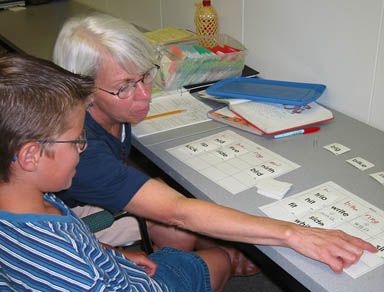
Word study activities teach students defining characteristics about words through the use of compare-contrast tasks. Students learn how patterns are spelled and how they sound. The open-ended nature of these activities allows for repetition and over-learning which is necessary to attain automaticity in reading words and to enable the orthographic features to become internalized. In addition, the gamelike structure keeps the student's motivation and interest high. The ultimate goal is for students to take knowledge and automaticity gained while doing these sorts and transfer this knowledge to reading unfamiliar words.
Following are examples of the word sort progression:
Picture Sorts
In picture sorting activities, pictures are sorted by inital phoneme or sound.
Focus:
- Introduces the concept of attending to the initial phoneme in words
- Develop automaticity in separating words by phonemes
- Helps establish foundational knowledge to begin learning simple (c-v-c) vowel patterns
Click here to download a PDF file of picture sort cards.
Onset-Vowel Word Families
In word family sorting activities, the initial consonant(s) and the vowel remain constant. Words are sorted into families or patterns.
Focus:
- Introduces the concept of categorizing words by pattern
- Simple words used (c-v-c) demonstrate the alphabetic nature of the spelling system
- Helps establish foundational knowledge against which other vowel patterns can be compared and contrasted
- Develop ability to quickly change final consonants when the onset-vowel unit is held constant
- Develop automaticity in (c-v-c) word recognition
Mixed Short Vowels
In non-rhyming short vowel sorts, the vowel and spelling pattern (c-v-c) remain the same. The words in the column do not rhyme; they merely share the same vowel and vowel sound.
Focus:
- To strengthen student's ability to use sound-symbol matching to decode simple (c-v-c) words
- To further increase student's automaticity in reading (c-v-c) words
- Mastery at this level ensures that the student will bring important knowledge to the one-syllable vowel-pattern stage
Vowel Patterns
The familiar c-v-c (short vowel) learned in earlier sorts is included each time a sort activity is done. In addition, three columns comprised of more difficult patterns are integrated into the sort. These include high-frequency one-syllable long vowel patterns.
Focus:
- Focus is on high-frequency one-syllable vowel patterns
- Students learn to attend to the "look" of the word (orthographic pattern) which in turn drives the "sound" of the vowel
Word Bank
Word banks are one way parents and educators can help students learn the high frequency, phonetically irregular words that make up such a large part of reading and writing (e.g., the, you, said, what, was). Follow this link for information on making a word bank.


 Steps"